What the Next Economy Shaped by Younger Generations Will Change
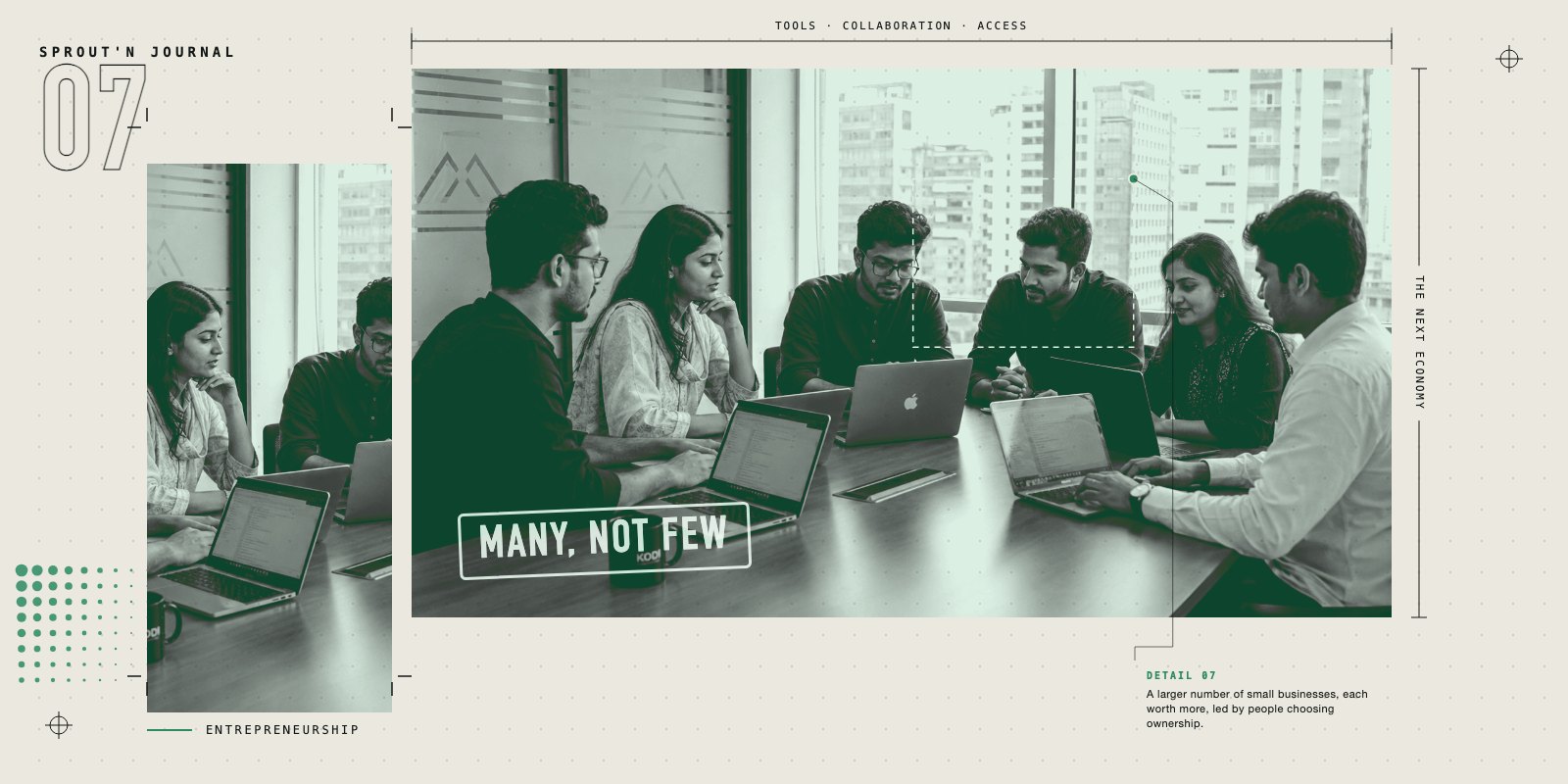
In short: we expect the next economy to be more fragmented and less dominated by large corporations, driven by a much larger number of small and medium sized businesses. Three things will decide how many of those businesses succeed: better tools for founders, collaboration instead of competition, and the accessibility that follows from both.
We think today's economy will change, and we are committed to helping shape it. To us, the future economy looks more fragmented and less dominated by large corporations when it comes to overall revenue and valuation. Setting aside capital intensive, deeply established and manufacturing heavy industries, we believe the next economy will be driven by a much larger number of small and medium sized businesses, each holding greater revenue potential and higher perceived value.
This shift will not happen quietly. It will be visible, intentional and largely powered by younger generations choosing a different path. So why do we believe in this future?
Why entrepreneurship will be the default
There is a generational interest in entrepreneurship at levels we have not seen before, and it keeps rising. Watching others build start-ups in public on social media has removed much of the mystery around building a business, and it has given people the push to take their own leap. Combined with growing access to resources and fewer technical barriers to entry, the reasons not to try are becoming scarce.
Recent surveys across North America found that just over half of Canadians and four in ten traditionally employed Americans have either started or are seriously considering starting their own business. We believe those numbers will continue to rise, not only in these countries but globally.
At the same time, Oxford Economics notes persistent financial strain among workers: a significant share of households could not cover a month of expenses if their income were interrupted. Even without a full recession, the current system is not working for the majority. People are struggling, and it is no longer a hidden reality.
As a result, more people are looking for a second income stream. For some it will remain supplemental. For others it will grow into something much bigger. Either way, the direction is clear: more people will try to build something of their own in the coming years and decades.
How entrepreneurship becomes the new age of the economy
The real question is not whether more people will try entrepreneurship. It is whether more of them will succeed. Raising the success rate is simpler than it seems, though it requires a real shift in how we think and act. There are three core ingredients: more tools, more collaboration and more access.
Combined correctly, these create a flywheel. More tools built for start-ups raise the odds of success and spread the know how. Greater collaboration lowers the barrier to entry and makes entrepreneurship feel attainable rather than intimidating. Together they make starting a business accessible, and accessibility brings in the next wave of founders, some of whom build the next tools.
We are already seeing this happen. In the age of AI, individuals can build the tools they need for their own business. From there the question becomes who else needs them and how to monetize them. Tools built for start-ups are fundamentally different from those designed for large enterprises. They need to be simple, affordable and practical.
The sooner high quality tools reach new founders, the easier it becomes to bet on yourself. Clearer paths reduce ambiguity, reduced ambiguity lowers fear, and when fear drops, action increases.
Collaboration over competition
The second ingredient takes both a mindset shift and a willingness to unlearn conditioned competition. Working together, sharing insights and genuinely supporting one another is not just idealistic. It is economically efficient.
There is more opportunity in the world than we tend to believe. Money is not as scarce as we are conditioned to think, and neither is demand. Nobody wears the same brand of clothing every single day, and the same logic applies to most products, services and solutions. Multiple businesses can win at the same time without cancelling each other out. Collaboration does not dilute success. It multiplies it.
Accessibility is the outcome
The final ingredient is a natural byproduct of the first two. When tools improve and collaboration increases, entrepreneurship becomes more accessible, both in perception and in reality. Accessibility reduces fear, and fear is the main reason most people never try.
Cooking is often described as chemistry. Reshaping the economy will take the same kind of precision. When the elements are combined thoughtfully, the result is something sustainable and scalable.
The quiet opportunity ahead
There is also an opportunity approaching beneath the noise of the AI boom. While many will rush to build an AI product for the sake of it, the real winners will use AI to improve conventional products, solve real problems and build authentic brands rooted in human connection.
Even as analysts predict continued growth in AI driven solutions, the hidden gems will be the businesses that prioritize personability, trust and genuine interaction. Technology will be the enabler, not the identity. Technology companies will keep winning, and there is still plenty of room for everyone else.
Who will define it
The economy as we know it will change dramatically in the coming years. It will be shaped by people choosing ownership over dependency, collaboration over competition and purpose over scale alone. The next economy will not be led by a few massive players but by many intentional ones.
Those who build early, build together and build with clarity will not just take part in this shift. They will define it. If you are one of them, start by asking what you have to leverage.